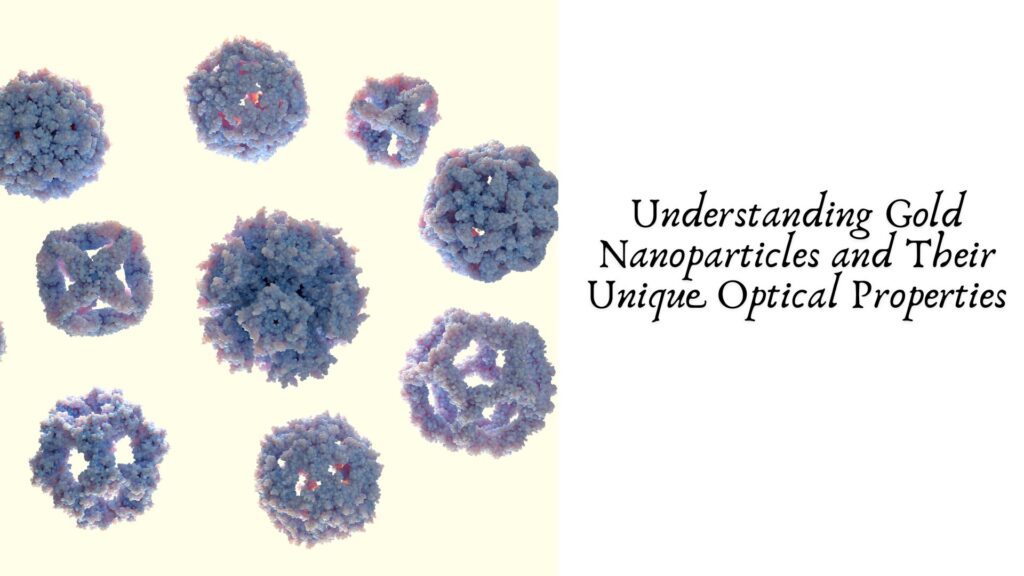

Gold has fascinated humanity for thousands of years, symbolizing wealth, beauty, and permanence. In the modern scientific era, however, gold has taken on an entirely new role—one that goes far beyond jewelry and currency. When gold is reduced to the nanoscale, typically between 1 and 100 nanometers, it exhibits remarkable optical behaviors that are dramatically different from bulk gold. These gold nanoparticles (AuNPs) have become central to advances in nanotechnology, medicine, electronics, sensing, and photonics.
This article explores what gold nanoparticles are, why their optical properties are so unique, and how these properties are being harnessed across diverse scientific and industrial applications.
What Are Gold Nanoparticles?
Gold nanoparticles are extremely small particles of gold whose size is comparable to biological molecules such as proteins and DNA. At this scale, classical physics gives way to quantum and surface-dominated effects. Unlike bulk gold, which appears metallic yellow, gold nanoparticles can appear red, purple, blue, or even colorless, depending on their size, shape, and surrounding environment.
Their high surface-to-volume ratio, chemical stability, biocompatibility, and tunable optical behavior make them one of the most widely studied nanomaterials.
Why Do Gold Nanoparticles Have Unique Optical Properties?
The extraordinary optical properties of gold nanoparticles arise primarily from a phenomenon known as Localized Surface Plasmon Resonance (LSPR).
Localized Surface Plasmon Resonance (LSPR)
LSPR occurs when the conduction electrons on the surface of a gold nanoparticle oscillate collectively in response to incident light. When the frequency of the incoming light matches the natural frequency of these electron oscillations, strong absorption and scattering occur.
This resonance leads to:
- Intense colors
- Strong light absorption
- Enhanced electromagnetic fields near the nanoparticle surface
These effects do not occur in bulk gold, making LSPR a defining feature of gold nanoparticles.
Color Changes and Size Dependence
One of the most visually striking aspects of gold nanoparticles is their color variability:
- ~10–20 nm particles: Ruby red
- ~30–50 nm particles: Deep red to purple
- Larger or aggregated particles: Blue or gray
As particle size increases:
- The plasmon resonance peak shifts toward longer wavelengths (red-shift)
- Light scattering becomes more dominant than absorption
This size-dependent color change has been known since ancient times, famously used in stained glass windows, long before the science behind it was understood.
Effect of Shape on Optical Properties
Shape plays a critical role in determining the optical response of gold nanoparticles:
- Spherical nanoparticles: Single plasmon resonance peak
- Gold nanorods: Two resonance modes (longitudinal and transverse)
- Nanostars and nanocages: Multiple resonance peaks and intense field enhancement
Gold nanorods, for example, can be engineered to absorb light in the near-infrared (NIR) region, which is particularly useful for biomedical imaging and photothermal therapy.
Influence of the Surrounding Environment
The optical behavior of gold nanoparticles is highly sensitive to their local environment:
- Refractive index of surrounding medium
- Surface coatings or functional molecules
- Aggregation state
Even small changes in the surrounding environment can cause measurable shifts in the plasmon resonance wavelength. This sensitivity forms the basis of many plasmonic sensors, capable of detecting biomolecules, toxins, or chemical changes at extremely low concentrations.
Light Absorption vs. Light Scattering
Gold nanoparticles interact with light in two main ways:
- Absorption: Converts light into heat (important for photothermal applications)
- Scattering: Redirects light (important for imaging and sensing)
Smaller nanoparticles tend to absorb more light, while larger particles scatter light more efficiently. By carefully selecting particle size and shape, scientists can design gold nanoparticles for specific optical functions.
Surface-Enhanced Optical Effects
Gold nanoparticles dramatically amplify electromagnetic fields at their surfaces, leading to enhanced optical phenomena such as:
- Surface-Enhanced Raman Scattering (SERS): Enables detection of single molecules
- Fluorescence enhancement or quenching: Used in bioimaging and diagnostics
- Nonlinear optical effects: Important for advanced photonic devices
These enhancements make gold nanoparticles powerful tools in analytical chemistry and spectroscopy.
Applications Driven by Optical Properties
Biomedical Imaging and Diagnostics
Gold nanoparticles are widely used in:
- Optical biosensors
- Lateral flow assays (e.g., pregnancy tests)
- Cellular and molecular imaging
Their strong optical contrast and biocompatibility make them ideal for real-time, non-invasive diagnostics.
Photothermal Therapy
By absorbing light and converting it into heat, gold nanoparticles can selectively destroy cancer cells when illuminated with specific wavelengths. Their tunable optical absorption allows treatment in the near-infrared range, where biological tissues are most transparent.
Sensing and Detection
Plasmonic gold nanoparticles are used in:
- Chemical sensors
- Environmental monitoring
- Food safety testing
Minute changes in optical signals can indicate the presence of specific analytes with high sensitivity.
Optoelectronics and Photonics
Gold nanoparticles are increasingly integrated into:
- Plasmonic waveguides
- Optical switches
- Metamaterials
Their ability to manipulate light at scales smaller than the wavelength of light opens new possibilities for miniaturized optical devices.
Stability and Durability of Optical Properties
Unlike many organic dyes or fluorescent probes, gold nanoparticles:
- Do not photobleach
- Maintain optical stability over long periods
- Resist chemical degradation
This durability is crucial for long-term sensing, imaging, and industrial applications.
Future Perspectives
Research into gold nanoparticles continues to evolve rapidly. Emerging directions include:
- Hybrid plasmonic–quantum systems
- Smart, responsive nanoparticle assemblies
- Sustainable and green synthesis methods
- Integration with artificial intelligence–driven sensing platforms
As fabrication techniques improve, even finer control over optical behavior will be possible, unlocking new applications across science and technology.
Conclusion
Gold nanoparticles represent a remarkable example of how materials can behave entirely differently at the nanoscale. Their unique optical properties—driven by localized surface plasmon resonance, size and shape effects, and environmental sensitivity—have transformed them into indispensable tools in modern nanoscience.
From vibrant colors and enhanced light–matter interactions to groundbreaking applications in medicine, sensing, and photonics, gold nanoparticles continue to illuminate new pathways in research and innovation. Understanding their optical behavior is not only a scientific pursuit but also a gateway to technologies that will shape the future.