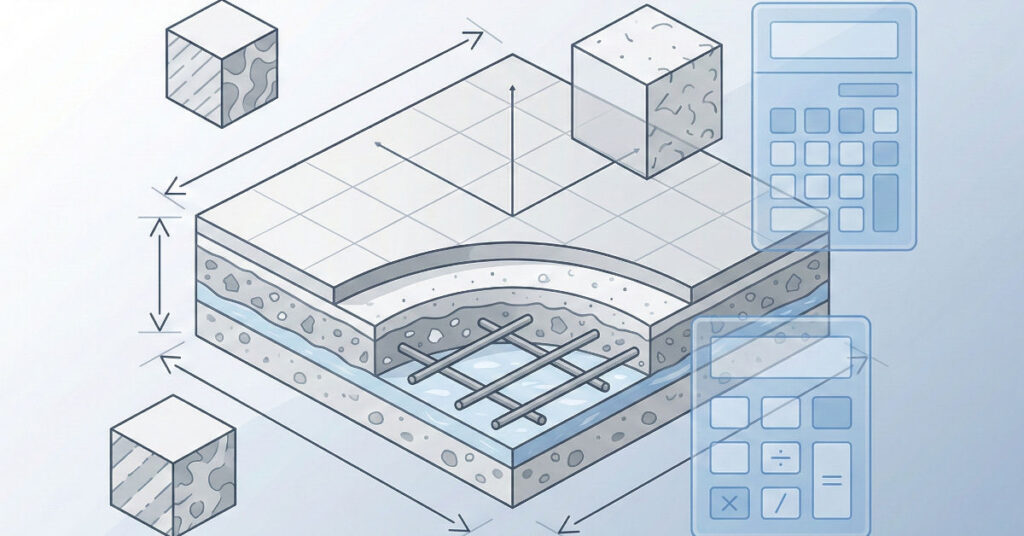

Concrete projects depend heavily on correct planning. Many construction issues arise not from poor execution, but from inaccurate quantity estimates made at the start. Ordering excess concrete increases costs and waste, while underestimating can delay work and compromise structural quality. Accurate estimation is essential for achieving efficient and predictable results.
Modern tools such as Concrete Verse, an easy-to-use Concrete Calculator, and a dedicated Concrete Slab Calculator help remove uncertainty from the planning stage. These tools allow users to convert measurements into accurate volume estimates, ensuring concrete work begins with confidence.
Why Concrete Estimation Accuracy Matters
Concrete is measured by volume, which means surface size alone is not enough. Depth and thickness have a significant impact on how much material is required. Even small errors in measurement can lead to major differences in the final quantity.
Concrete Verse helps users understand how length, width, and depth interact. By following a clear and structured calculation approach, users can avoid guesswork and rely on precise inputs. This improves planning accuracy and reduces unnecessary material costs.
Accurate estimation also supports better scheduling and coordination with suppliers.
Understanding the Purpose of a Concrete Calculator
A Concrete Calculator simplifies the process of estimating concrete volume. Instead of manually calculating formulas, users can enter basic dimensions and receive instant results.
Common Applications of a Concrete Calculator
Concrete calculators are widely used for:
- Driveways and walkways
- Patios and outdoor flooring
- Foundations and footings
- General residential concrete work
These tools help ensure the correct amount of concrete is ordered, preventing both shortages and excess material.
Improving Cost Control and Efficiency
Incorrect estimates often result in wasted resources or work stoppages. A concrete calculator reduces these risks by providing accurate volume estimates before materials are ordered. This leads to better cost control and smoother project execution.
Why Slab Estimation Requires Specialized Tools
Slab projects require higher precision than many other concrete applications. A Concrete Slab Calculator is designed specifically for flat surfaces where consistent thickness is critical for strength and durability.
How a Concrete Slab Calculator Works
A slab calculator focuses on three essential inputs:
- Slab length
- Slab width
- Slab thickness
Once these values are entered, the calculator determines the exact volume of concrete required. This ensures even distribution and proper curing across the entire slab.
Typical Uses for a Concrete Slab Calculator
Concrete slab calculators are commonly used for:
- Garage and utility floors
- Home extensions and additions
- Commercial and industrial slabs
- Workshops and storage areas
Accurate slab estimation directly affects long-term performance and structural reliability.
How Concrete Verse Enhances Planning Clarity
Concrete Verse plays a key role in helping users understand concrete estimation beyond simple numbers. It explains how calculations relate to real-world construction scenarios, making planning more intuitive.
For beginners, Concrete Verse provides clear explanations without technical complexity. For experienced professionals, it offers a consistent framework that can be applied across different projects. This combination improves decision-making and reduces planning errors.
By promoting structured calculation methods, Concrete Verse supports better outcomes at every stage of the project.
Benefits for Homeowners and DIY Builders
Homeowners and DIY builders often have limited budgets and little margin for error. Accurate estimation tools allow them to plan carefully and avoid unnecessary expenses.
Using a concrete calculator or concrete slab calculator helps users understand their material requirements before work begins. Concrete Verse adds further value by explaining how estimates are calculated, enabling users to make informed decisions.
This results in smoother project execution and fewer unexpected issues.
Advantages for Contractors and Construction Professionals
For contractors, accurate concrete estimation is closely tied to efficiency and profitability. Calculation errors can disrupt schedules, increase costs, and affect client confidence.
Concrete estimation tools help contractors:
- Improve material ordering accuracy
- Reduce downtime caused by shortages
- Maintain consistent estimation methods
- Support better cost forecasting
Concrete Verse helps standardize the planning process, making it easier for teams to work efficiently across multiple job sites.
Why Precision Is Critical Before the Pour
Concrete offers little flexibility once poured. Errors made during planning are often difficult and expensive to correct. Accurate estimation ensures proper curing, even finishes, and strong structural performance.
Using tools like a concrete calculator or concrete slab calculator encourages careful preparation and reduces avoidable risks.
Selecting the Right Estimation Tool
Not all concrete projects require the same level of detail. General work may only need a standard concrete calculator, while slab-based projects benefit from slab-specific estimation tools.
Concrete Verse helps users determine which tool best suits their project. Selecting the right calculator simplifies planning and ensures accuracy without unnecessary complexity.
Conclusion
Accurate concrete estimation is essential for successful construction planning. With the support of Concrete Verse, a reliable Concrete Calculator, and a precise Concrete Slab Calculator, estimating concrete becomes structured, clear, and dependable.
These tools help homeowners, contractors, and DIY builders reduce waste, control costs, and deliver consistent, high-quality results. When estimation is handled correctly from the beginning, concrete projects progress smoothly and achieve long-lasting performance.