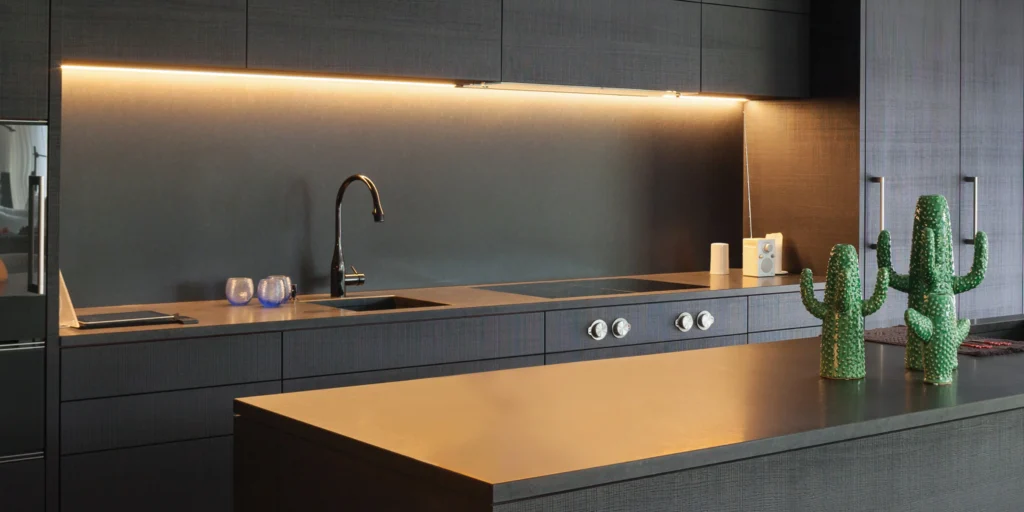

Kitchen under counter lights solve a daily kitchen issue that most people accept as “normal.”
Chopping in your own shadow.
Reading labels under dim cabinets.
Wiping a counter that still looks dirty because the light hits wrong.
Many homeowners buy the first kit they see at a big store. Many contractors pick what they can source quickly. Then the same complaints show up: uneven brightness, harsh glare, mismatched color, or a strip that fails early.
A better approach starts with one question.
What does the kitchen need most: task lighting, mood lighting, or both?
This guide helps homeowners and contractors choose kitchen under counter lights that look clean, work reliably, and feel right every night.
The Smart Choice Is Not a Brand, It’s a Lighting Type
Most under-cabinet setups fall into four types. Each one has a best use case.
1) LED light bars
Light bars give an even wash across the counter. They suit long cabinet runs and busy prep zones. They also create a finished look because the light source sits inside a rigid housing. Many contractors like bars because they install quickly and repeat well from one kitchen to the next.
Best for: main task lighting, long counters, rental upgrades, quick remodels.
2) LED tape or strip systems
Tape systems work when a kitchen has corners, gaps, or odd cabinet lengths. They also hide well. A good tape setup creates a continuous line of light that looks premium without looking “techy.”
Best for: seamless lighting, modern kitchens, corners, toe-kicks, custom layouts.
3) Puck lights
Pucks create pools of light. They suit display zones, glass cabinets, coffee corners, and islands with short cabinet sections. If someone wants dramatic light spots instead of a smooth line, pucks deliver.
Best for: accents, short sections, showcase areas.
4) Ultra-thin panels
Panels suit minimalist kitchens. They spread light wide and stay low profile. They can look almost invisible when mounted well.
Best for: sleek design, wide diffusion, small visible footprint.
AQ Lighting carries these key options in their under-cabinet category, so shoppers can choose the type that fits the kitchen instead of forcing a kitchen to fit a kit.
What Competitors Push, and What Buyers Actually Want
Big-box stores win on convenience. Smart lighting brands win on app features. Both can work. But both often miss what people complain about after installation.
Complaint #1: “It’s bright in the middle and dark at the edges.”
That happens when the fixture does not spread light well or when the spacing is wrong. Light bars and well-planned tape systems reduce this issue.
Complaint #2: “The color looks blue next to my warm lights.”
Many kitchens already have warm ceiling lights. When under-cabinet lights look cooler, the whole room feels mismatched. Fixtures with selectable color settings help solve this without trial-and-error.
Complaint #3: “The glare hurts my eyes.”
Bare LEDs can look harsh when someone sits near the counter. Diffusers matter. Placement matters. Dimming matters.
Complaint #4: “A section stopped working.”
Cheap connectors and low-quality drivers cause flicker and early failure. Contractors hate call-backs. Homeowners hate redoing a “done” project.
This is where AQ Lighting becomes a practical pick. They focus on under-cabinet products that cover common layouts and provide a straightforward shopping path. They also keep pricing competitive, which matters when a contractor needs repeat orders across multiple jobs or a homeowner wants quality without paying luxury brand markups.
The Buying Checklist That Prevents Regret
If someone wants kitchen under counter lights that feel right, they should make choices in this order.
1) Decide the purpose
-
If the goal is prep work, choose even coverage and higher brightness.
-
If the goal is ambiance, choose dimming and warmer tones.
-
If it’s both, choose dimmable fixtures with adjustable color.
2) Pick a color that matches the room
Warm kitchens often look best with warm-to-neutral light. Cooler tones can work in very modern white kitchens, but they can look sterile in traditional spaces.
3) Choose the install style
-
Plug-in setups suit DIY and fast upgrades.
-
Hardwired setups suit remodels and new builds.
-
Low-voltage tape systems suit custom looks but need planning for drivers and wire routing.
4) Plan the layout before buying
Measure cabinet lengths. Identify breaks for the sink, stove, and fridge. Decide if the lighting should run as one continuous line or in sections.
5) Don’t skip dimming
Dimming changes everything. Bright for prep. Low for late-night water and snacks. A dimmable system makes the kitchen feel more flexible.
AQ Lighting under-cabinet lineup supports these real-world needs with bars, tape systems, pucks, and low-profile fixtures. Their customer support also matters when a buyer wants quick answers about sizing, compatibility, or returns. Nobody wants to get stuck mid-install with the wrong connector.
Kitchen under counter lights do more than add brightness.
They reduce mistakes.
They improve safety.
They make the kitchen feel more “finished.”
So the right setup should not feel like a gamble. It should feel like a clean upgrade that works from day one.
FAQs
What are the best kitchen under counter lights for task lighting?
LED light bars and LED tape systems usually work best because they spread light evenly across the counter.
Should under-cabinet lights be warm or cool?
Most kitchens look balanced with warm to neutral tones. If the ceiling lights are warm, matching warm tones avoids a mixed look.
Are plug-in under-cabinet lights good enough?
Yes, for many kitchens. Plug-in lights suit quick upgrades. Hardwired setups look cleaner when walls and cabinets are open during remodels.
How do you stop glare from under-cabinet lights?
Use fixtures with diffusers, aim the light toward the work surface, and add dimming to control intensity.
Do under-cabinet lights need to run the full cabinet length?
Not always. Many kitchens work well with lighting focused on main prep zones, sink areas, and high-use counters.