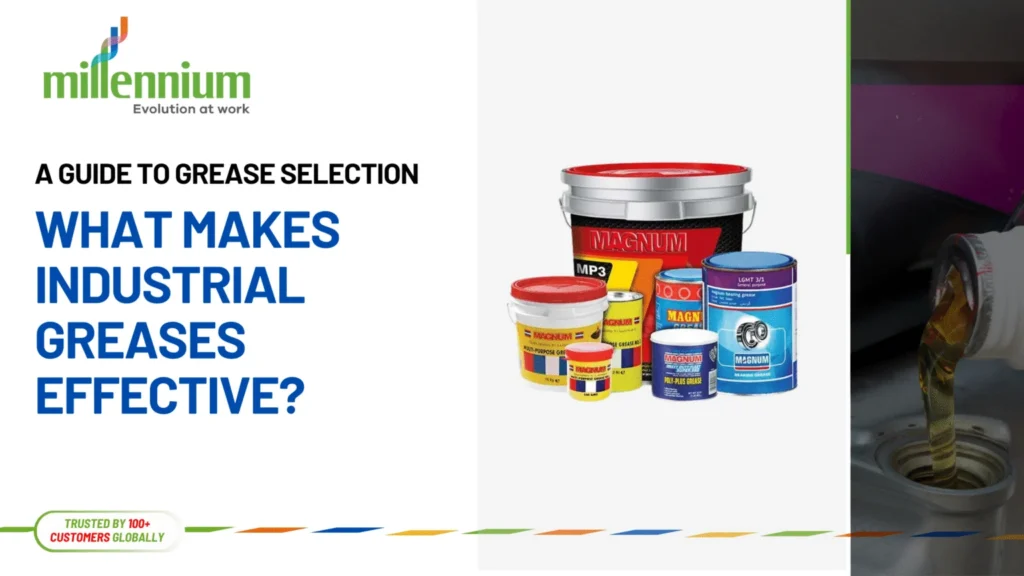

Industrial greases play a critical role in keeping machinery operating smoothly under demanding conditions where liquid lubricants alone may not suffice. From heavy-load bearings to slow-speed equipment and high-temperature environments, the right grease can significantly improve reliability, reduce maintenance costs, and extend equipment life. Understanding what makes industrial greases effective—and how to select the right one—is essential for engineers, maintenance teams, and plant managers.
A Brief Overview of Industrial Grease
Industrial grease is a semi-solid lubricant composed of three primary components: base oil, thickener, and additives. The base oil (mineral, synthetic, or bio-based) provides lubrication, while the thickener gives grease its structure, allowing it to stay in place. Additives enhance performance by improving properties such as wear protection, oxidation resistance, corrosion inhibition, and extreme-pressure capability.
Unlike oils, greases remain where they are applied, making them ideal for components that are difficult to access, operate under shock loads, or require long lubrication intervals. Greases also act as a sealing barrier, preventing contaminants such as dust, moisture, and chemicals from entering sensitive components.
The effectiveness of an industrial grease depends on how well its formulation matches the operating conditions—temperature, load, speed, environment, and re-lubrication frequency.
Comparison of Grease Types
Selecting the correct grease starts with understanding the major types of industrial greases and their characteristics. The thickener system largely determines a grease’s performance.
1. Lithium-Based Greases
Lithium greases are the most widely used industrial greases due to their versatility and cost-effectiveness. They offer good mechanical stability, moderate water resistance, and reliable performance across a broad temperature range. These greases are commonly used in bearings, electric motors, and general industrial applications.
2. Lithium Complex Greases
Lithium complex greases provide higher dropping points and improved resistance to heat compared to conventional lithium greases. They perform well under heavy loads and elevated temperatures, making them suitable for steel plants, paper mills, and automotive manufacturing.
3. Calcium and Calcium Sulfonate Greases
Calcium-based greases excel in water resistance and corrosion protection, making them ideal for wet or humid environments. Calcium sulfonate greases also offer excellent extreme-pressure performance and inherent rust inhibition, often eliminating the need for additional additives.
4. Polyurea Greases
Polyurea greases are known for long service life and oxidation resistance, especially in high-temperature applications. They are frequently used in electric motors and sealed-for-life bearings where extended lubrication intervals are required.
5. Aluminum Complex Greases
These greases provide good water resistance, adhesion, and load-carrying ability. They are commonly used in food-grade and specialty industrial applications where washout resistance is important.
Applications of Industrial Greases
Industrial greases are used across a wide range of industries and equipment types, each with specific performance demands.
Bearings and Rolling Elements
Greases reduce friction, protect against wear, and dissipate heat in rolling and plain bearings. The correct grease ensures smooth operation even under heavy loads or variable speeds.
Heavy Machinery and Construction Equipment
Excavators, loaders, and crushers rely on greases that can withstand shock loads, vibration, and dusty environments. High EP greases help prevent metal-to-metal contact under extreme conditions.
Steel, Cement, and Mining Industries
These industries demand greases that can tolerate high temperatures, heavy loads, and contamination. Lithium complex and calcium sulfonate greases are often preferred due to their thermal stability and load-carrying capacity.
Electric Motors and Fans
Low-noise operation, oxidation resistance, and long life are critical. Polyurea and specially formulated lithium greases are commonly used to meet these requirements.
Marine and Wet Environments
Water-resistant grease protect components exposed to moisture, saltwater, and washdowns. Calcium-based greases perform exceptionally well in such conditions.
MAGNUM Grease Product Fit
MAGNUM Industrial Greases are engineered to meet the diverse demands of modern industrial operations, combining high-quality base oils, advanced thickener systems, and performance-enhancing additives.
Key Attributes of MAGNUM Greases:
-
Excellent load-carrying capacity for heavy-duty industrial equipment
-
Superior thermal stability, ensuring performance at elevated temperatures
-
Strong resistance to water washout and corrosion, extending component life
-
Outstanding mechanical stability, maintaining consistency during prolonged operation
-
Reduced wear and friction, leading to improved energy efficiency and reliability
MAGNUM offers a comprehensive range of greases, including lithium, lithium complex, calcium-based, and specialty formulations, making it easier to select the right grease for specific applications. Whether used in bearings, gear couplings, construction equipment, or high-temperature industrial processes, MAGNUM greases provide dependable performance and longer re-lubrication intervals.
Conclusion
Industrial grease effectiveness depends on choosing the right formulation for the operating environment and application. Understanding grease composition, comparing grease types, and matching performance characteristics to real-world conditions are essential steps in proper grease selection. With a well-engineered product range, MAGNUM Industrial Greases deliver reliable lubrication solutions that help industries minimize downtime, protect critical assets, and achieve long-term operational efficiency.