
Phobias are among the most common anxiety disorders, affecting thousands of Australians each year. Whether it’s an intense fear of flying, spiders, needles, or social situations, phobias can interfere with daily life, relationships, and overall well-being. While Classical Conditioning and phobias may feel overwhelming, psychology offers powerful tools to understand and treat them.
One of the most effective and well-established approaches is classical conditioning. By understanding how fears are learned, psychologists can help individuals “unlearn” their phobias using evidence-based techniques. This article explores how Classical Conditioning and Phobias are connected and how this psychological principle is used in modern therapy across Australia.
What Are Phobias?
A phobia is an intense, irrational fear of a specific object, situation, or activity. Unlike general fear, phobias provoke immediate anxiety and avoidance, even when there is little or no real danger.
Common Types of Phobias
Phobias are typically grouped into three main categories:
- Specific phobias – such as fear of spiders (arachnophobia), heights (acrophobia), or flying
- Social anxiety disorder – fear of social judgment or embarrassment
- Agoraphobia – fear of being in places where escape might feel difficult
In Australia, specific phobias are particularly common and often develop during childhood or adolescence, though they can also appear later in life.
Understanding Classical Conditioning
To understand how phobias develop and how they can be treated, it’s important to first understand classical conditioning, a foundational concept in psychology.
What Is Classical Conditioning?
Classical conditioning is a learning process first identified by Russian psychologist Ivan Pavlov. It occurs when a neutral stimulus becomes associated with a meaningful stimulus, producing a learned response.
In simple terms:
- A neutral stimulus initially produces no fear
- It becomes paired with a fear-provoking event
- Over time, the neutral stimulus alone triggers fear
This process explains how many phobias begin.
The Link Between Classical Conditioning and Phobias
The relationship between Classical Conditioning and Phobias lies in how fear responses are learned. A phobia often forms after a negative or traumatic experience, even if that experience happens only once.
Example of Classical Conditioning in Phobias
Imagine a child who is bitten by a dog:
- Unconditioned stimulus: Dog bite
- Unconditioned response: Pain and fear
- Neutral stimulus: Dogs
- Conditioned stimulus: Dogs (after the incident)
- Conditioned response: Fear of dogs
From that point on, the child may experience fear whenever they see or hear a dog even if the dog is harmless.
This learned fear can persist into adulthood unless it is actively addressed.
Why Phobias Persist Over Time
Once a phobia has formed, it often strengthens due to avoidance behaviour. Avoidance temporarily reduces anxiety, which reinforces the fear.
For example:
- Avoiding spiders prevents anxiety
- The brain learns that avoidance = safety
- The fear never has a chance to fade naturally
This is why phobias rarely disappear on their own and often require psychological intervention.
Using Classical Conditioning to Treat Phobias
The same learning process that creates phobias can also be used to treat them. Modern therapies aim to break the conditioned fear response and replace it with a neutral or calm response.
Exposure Therapy
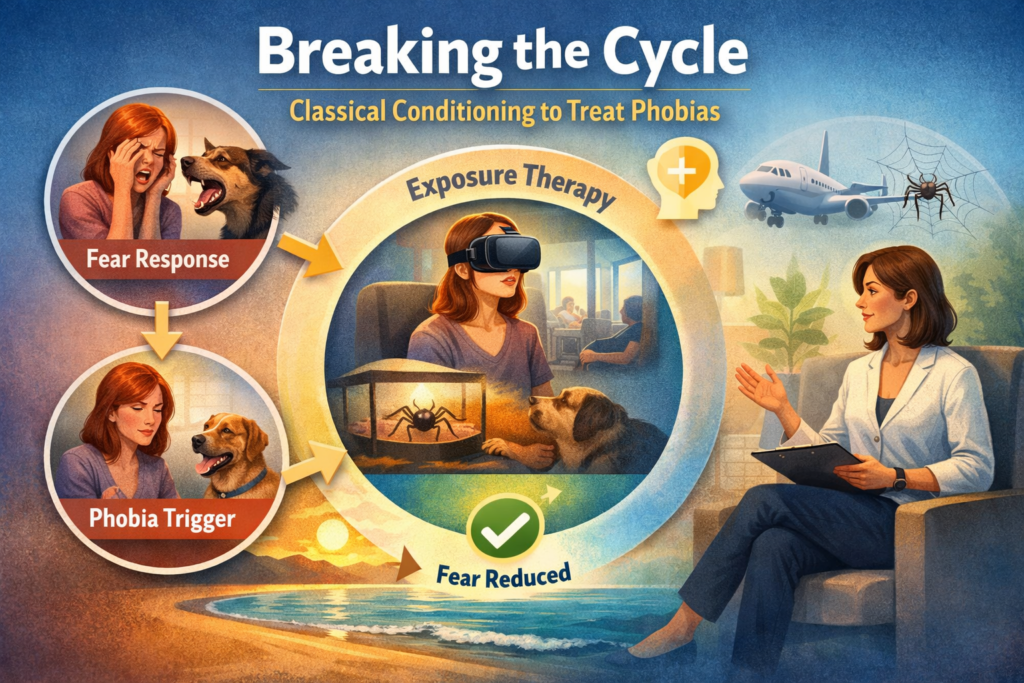
Exposure therapy is the most common treatment approach based on classical conditioning principles. It involves gradually and safely exposing a person to the feared stimulus until the fear response weakens.
This process is known as extinction, where the conditioned response fades over time.
Types of Exposure Therapy
- Gradual exposure – starting with mild exposure and building up
- In-vivo exposure – real-life exposure to the feared object
- Imaginal exposure – visualizing the feared situation
- Virtual reality exposure – increasingly used in Australia for phobias like flying
Systematic Desensitization Explained
Systematic desensitization is a structured form of exposure therapy rooted in classical conditioning.
How It Works
- Relaxation training – learning techniques such as deep breathing
- Fear hierarchy – listing fear-provoking situations from least to most intense
- Gradual exposure – facing each level while remaining relaxed
By pairing relaxation with the feared stimulus, the brain learns a new association: safety instead of fear.
Counterconditioning: Replacing Fear Responses
Counterconditioning is another method derived from classical conditioning. It involves replacing the fear response with a competing emotional response, such as calmness or confidence.
For example:
- Fear of needles is paired with controlled breathing
- Fear of flying is paired with grounding techniques
- Fear of social situations is paired with positive reinforcement
Over time, the original fear response weakens.
Is Classical Conditioning-Based Therapy Effective?
Research consistently shows that therapies based on Classical Conditioning and Phobias are highly effective.
Evidence-Based Outcomes
- Significant reduction in anxiety symptoms
- Long-term improvement when avoidance is addressed
- Effective for children, adults, and older Australians
- Can be delivered face-to-face or via telehealth
In Australia, exposure-based therapies are widely recommended by mental health professionals and clinical guidelines.
Telehealth and Phobia Treatment in Australia
With the rise of telehealth services across Australia, phobia treatment has become more accessible than ever.
Benefits of Online Therapy
- Access from regional and remote areas
- Comfortable, familiar environment
- Effective for many phobias using guided exposure
- Medicare-supported sessions with eligible referrals
Psychologists can guide exposure exercises remotely while ensuring safety and progress.
When to Seek Professional Help
While mild fears are common, professional help may be needed if:
- Fear causes intense distress
- Avoidance interferes with work or relationships
- Symptoms include panic attacks or physical reactions
- The phobia has persisted for six months or more
Early intervention can prevent phobias from becoming more severe over time.
The Role of a Psychologist
A registered psychologist helps by:
- Identifying how the phobia developed
- Explaining the conditioning process
- Creating a personalized exposure plan
- Teaching coping and relaxation skills
- Supporting long-term recovery
At ExpertMinds, evidence-based psychological approaches are used to help Australians break free from fear and regain control of their lives.
Breaking the Cycle of Fear
Phobias may feel deeply ingrained, but they are learned responses and learned responses can be changed. By understanding the connection between Classical Conditioning and Phobias, individuals gain insight into why their fears exist and how they can be treated safely and effectively.
Through exposure therapy, systematic desensitization, and counterconditioning, many Australians successfully overcome phobias every year. With the right support and evidence-based care, it is possible to break the cycle of fear and move forward with confidence.
Final thought
Phobias are not signs of weakness but learned fear responses that can be changed with the right psychological approach. By understanding the link between Classical Conditioning and Phobias, individuals can see how fears develop and, more importantly, how they can be unlearned through evidence-based therapies such as exposure and systematic desensitisation. With professional support and consistent practice, many Australians are able to reduce avoidance, regain confidence, and improve their quality of life proving that it is possible to break the cycle of fear and move forward with greater resilience and control.